Back
Diversity in Tech: Breaking Barriers & Unlocking Opportunities for Black Innovators
Explore the current landscape of diversity in tech, its challenges, and the opportunities for inclusive growth and change.

Why do some of the biggest tech innovations come from diverse teams, yet Black professionals remain underrepresented in the industry?
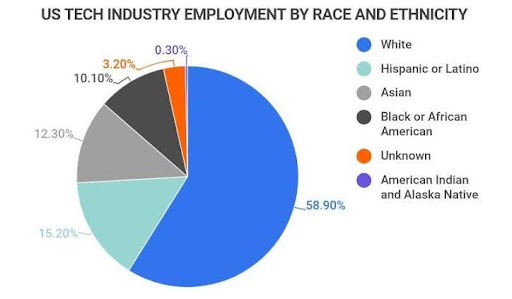
In the U.S., women make up 47% of the workforce, yet they hold only 28% of computer and math jobs. Since 1984, female representation in IT has declined, with women now making up just 21% of IT professionals.
Diving into the tech world's hurdles, we see their ripple effect on crafting new products.
This article explores the crucial steps organizations are taking to cultivate inclusive workplaces, from enriching learning opportunities to fostering a welcoming office culture. These efforts are paving the way for a tech landscape that truly reflects the diversity of our world.
Understanding Tech's Diversity Problem: Historical Context.
Fundamentally, tech’s diversity challenges date back to the Civil Rights era, when the first employee resource groups (ERGs) were formed to promote equal pay and workplace fairness.
While progress has been made, representation of Black professionals and women in tech has remained stagnant over the years.
Black workers in tech showed little improvement between 2014 and 2022. Female representation also stayed almost the same.
However, the tech industry's diversity has gotten worse over time. The percentage of Black computer science majors dropped from 11% in 2008 to less than 9% by 2018. Women's numbers in computer science programs fell from 27% in 1998 to 20% in 2018.
Understanding Tech’s Diversity Problem: Current challenges.
Systemic barriers in the tech industry continue to worsen underrepresentation. Black employees make up 13% of the overall workforce but hold just 4% of tech positions. Hispanic workers represent 17% of the workforce but fill 8% of STEM jobs.
These current challenges extend beyond hiring numbers:
- Poor company culture remains the main reason women quit tech positions.
- 57% of women experience gender discrimination, compared to 10% of men.
- Half of Black professionals encounter racial discrimination in tech.
- The wage gap keeps widening - Hispanic STEM workers' pay dropped from 85% to 83% of white workers' pay between 2016 and 2019.
Even so, age makes tech's diversity problems even trickier. Young people dominate the workforce, with 41% of workers aged 25-39. The number of tech workers over 40 dropped from 56% to 52% between 2014 and 2022.
Benefits of diverse team?
- Teams with different backgrounds make better choices and have an 87% higher chance of doing well.
- Companies with a mix of people come up with new ideas and solve problems better.
- Teams with all sorts of folks create stuff that works for more users and think about how easy it is to use.
- Tech teams with different kinds of people can spot and fix issues in diverse ways that suit diverse clients.

Products become more inclusive and available when teams mirror their global user base. Customer satisfaction and market reach improve when team diversity lines up with customer demographics. Fresh perspectives from diverse teams help companies learn about and address a wider range of user needs.
STRATEGIES TOWARDS TECH DIVERSITY
- Education.

Education provides critical support to help bridge technology’s diversity gaps. To make tech careers more accessible, some specific educational programs has been developed, aimed at inclusive pathway creation.
Tech diversity expansion benefits from early intervention programs which show promising results. High school students who participate in tech job fairs and internships can discover technical careers they previously didn't know existed. Amazon's AHEAD program gives students from ages 8 to 18 hybrid learning experiences. Students explore multiple routes to reach high-tech professions.
Favorably, these initiatives show measurable results. Low-income areas witness a 5% rise in underrepresented minority student enrollment when their schools offer advanced computer science courses. The participation in diversity initiatives produces a 25% increased confidence for students to work in diverse workplaces.
- Mentorship Initiatives
According to a study by Harvard Business Review, those companies that have adopted mentorship programs have seen the number of minorities in management rise from 9 to 24 percent. The research highlights that those firms which have well-defined mentorship policies have a 50% higher presence of people in tech roles.
Beyond statistics, there are more advantages. Mentorship can help close the tech gap for black professionals, these programs are helpful in addressing imposter syndrome, which is more common among people from underrepresented groups in tech.
For example, Microsoft and Mt. Holyoke College's initiative includes both near-peer mentoring as well as industry-led guidance. Some 1,000 plus students have been engaged and 40 percent of these subjects are both women and people of color.
According to Forbes, employees are happy, engaged, and productive when their individual needs and the needs of the organization are in sync.
Thus, the approach provides multiple entry points into technology careers. These programs provide very important support systems and practical paths for underrepresented groups to enter and to do well in the tech industry no matter what their background is.
-
Remote work impact
Remote work has transformed diversity in the tech sector. Companies now report a 63% increase in gender diversity and a 43% rise in ethnically diverse candidates. Their data also shows a 22% increase in neuro-diverse applicants.
Remote work benefits go beyond just hiring numbers. 64% of people of color who work remotely can manage stress better, and 50% feel they belong more in their organizations. Virtual workspaces create safe environments where underrepresented groups can excel.
Teams with high racial, gender and ethnic diversity are 35% more likely to perform better financially.
Solutions for Inclusion Through Technological Innovations
Tech companies are finding new ways to encourage inclusion through innovative solutions. Their diversity numbers shows real progress when they put the following tools to work:
- AI-powered hiring tools.
AI recruitment systems help companies reduce hiring biases by evaluating candidates objectively. Companies that used AI-powered tools for unbiased screening showed a 71% improvement in workforce diversity.
Mark Dean made this realistic with his co-invention of the IBM and personal computer. Making him and many others among the top Black Tech Pioneers Who Are Changing The Game.
Fundamentally, the system focused on skills and experience rather than demographic factors .
These systems help companies find talented people they might have missed before. A great example is Unilever, which achieved a 16% increase in gender diversity among new hires by using AI recruitment platforms.
- Analytics for diversity tracking.
Analytical insights help organizations track and improve their inclusion efforts. Companies that use diversity analytics spot gaps in departments, roles, and pay levels. These tools analyze recruitment data to find roadblocks that affect diverse candidates.
Companies using metrics-based diversity tracking look at:
- How applicant demographics compare to actual hires.
- How long different groups stay with the company.
- Patterns in pay equity.
- Who gets promoted and why?
Advanced analytics platforms do more than track simple metrics. They show companies which DEI programs work best. This helps businesses make smart choices about where to invest and what to improve.
- Virtual collaboration platforms
Digital platforms create inclusive workspaces by connecting talent from around the world. These tools work especially well for underrepresented groups. About 84% of employees prefer a mix of remote and office work.
Virtual collaboration tools encourage inclusion by:
- Using AI translation to overcome language differences.
- Creating workspaces anyone can use.
- Making global mentorship possible.
- Supporting flexible work schedules.
Occasionally, teams using these platforms communicate better across cultures. These tools create spaces where everyone's voice matters, which leads to better teamwork and higher productivity.
Companies need to think carefully about how they use these tech solutions. AI models must learn from diverse data sets to avoid copying old biases. Companies also need clear rules about how they handle DEI data while keeping everything private and secure.
Conclusively, the tech industry needs to address its diversity challenges now. We have a long way to go, but we can build on this progress through collective action. Teams with diverse backgrounds consistently show better financial outcomes. They make wiser decisions and develop products that work for everyone.
Companies that switched to remote work policies saw great results. Their candidate diversity increased by 92%.
Subsequently, training programs makes a real difference, especially when you have other learning paths and strong mentorship support. AI-powered hiring tools and analytics platforms help companies track and improve their diversity goals. As well as flexible policies and flexible working hours, which helps companies keep their employees longer and see better engagement.
Success depends on everyone's involvement. Black tech is different, simply recreating black magic into groundbreaking technologies. Companies should keep investing in workplace cultures that welcome all voices. They need to create more learning opportunities and remove bias from hiring.
These steps will make individual companies stronger. Want to be part of the change? Explore our resources on Black tech innovators and mentorship opportunities here. InBlackTechWeTrust
How can we be of help to you?
Lorem ipsum dolor sit amet, consectetur adipiscing elit. Suspendisse tincidunt sagittis eros. Quisque quis euismod lorem. Etiam sodales ac felis id interdum.

Join our mailing list to get the latest news
.svg)


Copyright © 2025 In Black Tech We Trust